Artificial intelligence can now create photos, videos, music and texts that are at first glance indistinguishable from reality. The European Union is introducing new rules aimed at increasing transparency and limiting the spread of misleading content.
New rules for labeling certain content created by artificial intelligence will apply across the European Union from 2 August 2026. They stem from the AI Act – the first comprehensive law ever to regulate artificial intelligence. Their aim is not to ban AI, but to ensure greater transparency and user trust.
What's changing?
The new rules do not prohibit the use of artificial intelligence. They aim to ensure that users can recognize content that has been created or edited with AI.
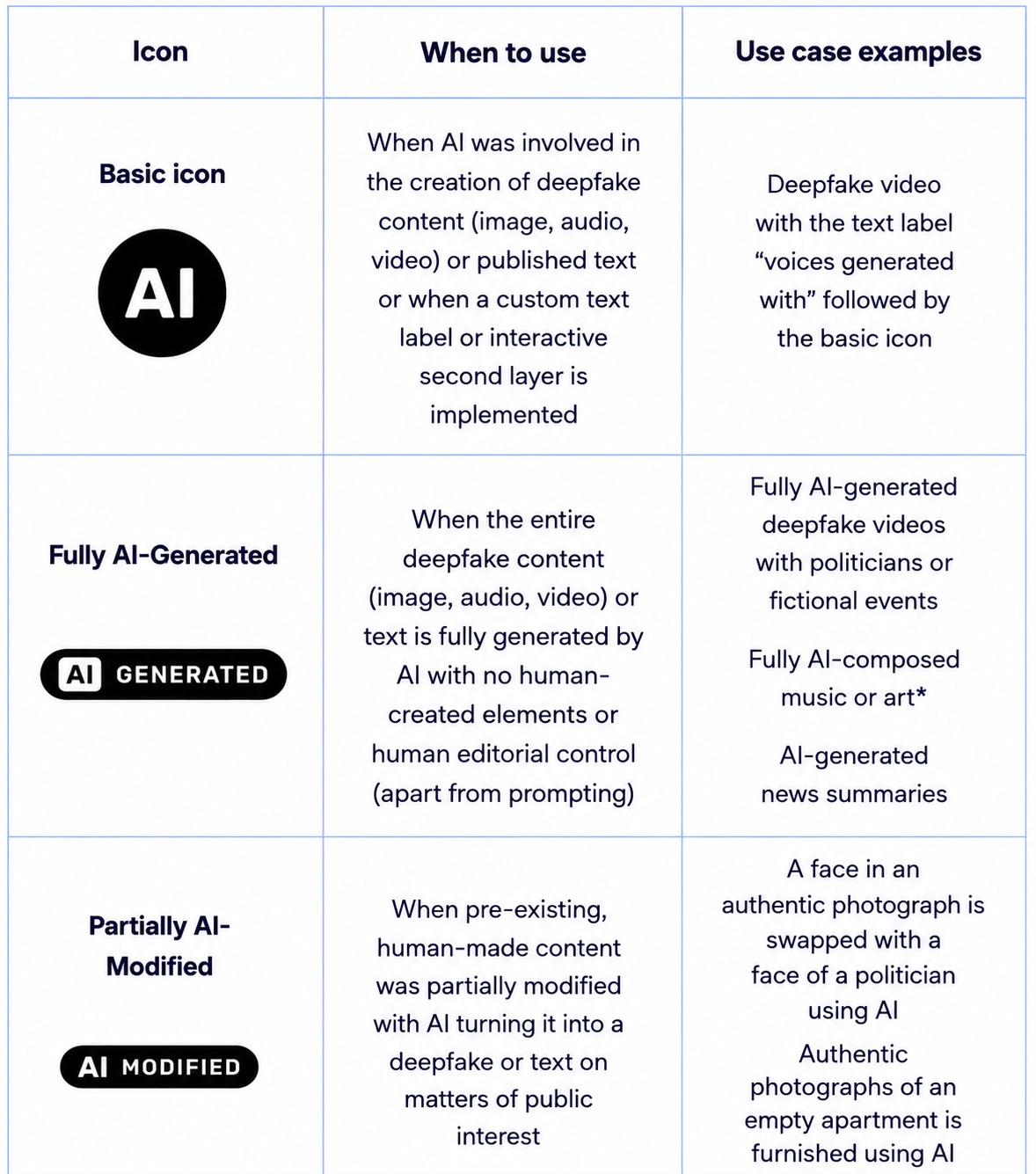
The European Union has therefore also prepared a uniform set of icons that creators can use when labeling AI content.
However, it is important to know one thing:
The use of these icons is voluntary. The obligation is the labeling of the content itself, not the specific graphic form of the labeling.
What content will need to be labeled?
Not all AI-generated content is subject to this obligation.
The AI Act focuses on two areas in particular.
Deepfake content
This includes photos, videos or audio recordings created or edited by AI that can appear to be real.
Examples:
face swapping of a person in a video,
artificially created speech by a politician,
realistic video of an event that never happened,
AI voice imitating a specific person.
If an ordinary person could get the impression that the content is authentic, it must be labeled appropriately.
⸻
AI texts on topics of public interest
The obligation may also apply to texts created by AI if:
they inform the public about topics of public interest,
they have not undergone human review or editing,
and no one bears editorial responsibility for their content.
So if AI publishes news itself without human supervision, labeling is mandatory.
⸻
When is labeling not necessary?
The AI Act also considers situations where mandatory labeling would not make sense.
Exceptions include, for example:
works of art,
satire,
fiction,
creative content,
films,
advertisements with a clearly artistic character.
Even in these cases, however, it may be appropriate to inform the user that the content was created using AI. The law only allows this to be done in a way that does not disrupt the experience of the work.
Similarly, the obligation does not apply to AI texts that have undergone human editing and a specific person or company is responsible for their publication.
⸻
What do the new AI icons look like?
The European Union has prepared three basic labels:
AI involved – AI participated in the creation of the content,
Fully AI-generated – the content was completely created by artificial intelligence,
Partially AI-modified – the original content was modified using AI.
They are available in black and white versions, including transparent variants.
⸻
Where should the icons be placed?
If you decide to use the official EU icons, they should be:
visible when the content is first viewed,
placed directly in the video, image or text (if possible),
preserved even when sharing or downloading the content,
sufficiently large and legible.
It is also recommended to supplement them with a simple text explanation instead of unclear abbreviations.
⸻
Does this also apply to marketing agencies?
Yes.
If your business uses AI to create photos, videos or advertising materials, it’s worth checking to see if the content falls under the AI Act.
Most regular marketing campaigns won’t require labeling. However, if you’re creating realistic AI videos or photos that can appear authentic, the new rules may apply to you.
⸻
What do we recommend businesses do today?
While many businesses don’t yet have clear policies in place for their use of AI, it’s a good idea to start preparing for the new requirements.
We recommend:
creating internal policies for the use of AI,
recording where AI has been used,
considering labeling for realistic AI visuals today,
monitoring the further development of the AI Act and its guidelines.
Transparency will be an increasingly important part of brand credibility.
⸻
Conclusion
Artificial intelligence is changing the way content is created. The European Union therefore does not want to restrict its use, but to ensure that people can distinguish between what is authentic and what was created using AI.